
Research Excellence Framework
Impact Case Study
Structured account of the reach and significance of the Music-Centred Dementia Care programme at UCA, led by Whalley and Brill, 2018–2025. Follows the REF Impact Case Study template: summary, underpinning research, references, details of the impact, and sources to corroborate.
6years
Song-Task Association embedded in daily practice at Pendine Park
2019 – present · 70-resident specialist dementia care
200+
Family and professional carers using the COGS digital-CST app across England
Co-designed with Memory Matters (Plymouth) · since 2023
380
Audience at the world premiere of 'On Memory' at Kings Place
London · 27 May 2023 · with Adam Zeman, Alexander McCall Smith
16participants
24-week ACT trial at Lifecare dementia club
Edinburgh · 2023 · 2 GP referrals triggered by ACT alerts
31participants
MedTracks feasibility study with NHS Highland
Inverness · Dec 2024 – Feb 2025 · Cohen's d = 0.633
£60K
UKRI Zinc Catalyst Award for ACT development
Healthy Ageing strand · 2023 – 2024
1 — Summary of the impact
In one paragraph.
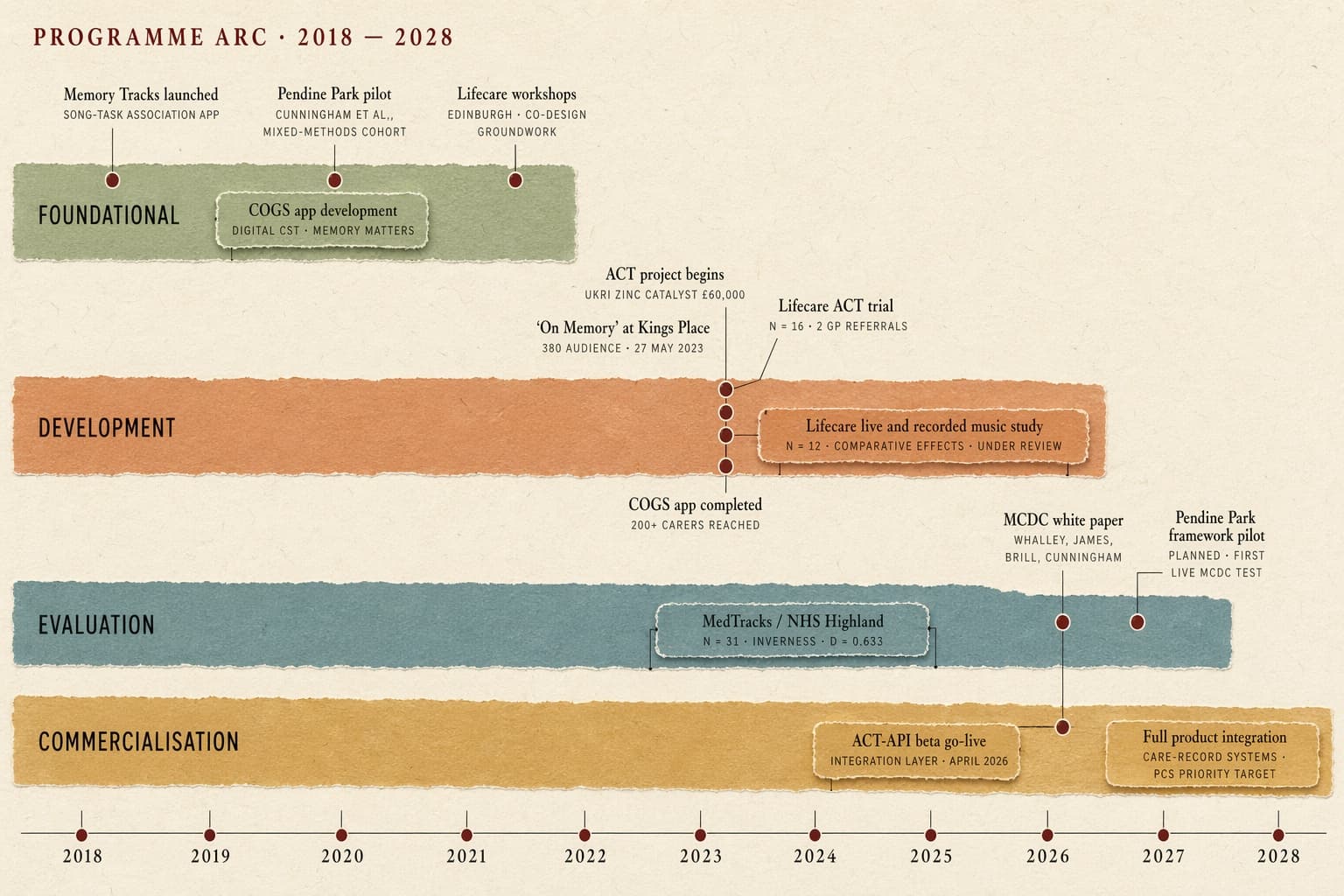
Research at the University for the Creative Arts has developed music-centred digital tools that enable earlier detection of deterioration and improved care for people living with dementia. Since 2020 the work has produced sustained practice change in care settings, wider access to evidence-based therapy, and earlier health interventions. The Anticipatory Care Tool (ACT), co-designed with care organisations, has enabled early identification of decline in trial participants, triggering timely GP referrals. The COGS app has removed training barriers to Cognitive Stimulation Therapy (CST), reaching an estimated 200+ carers nationwide. Together the work improves continuity of care and supports prevention of avoidable hospital admissions.
2 — Underpinning research
What was researched, and by whom.
Research at UCA, led by Dr J. Harry Whalley (employed 2017–present) and Mark Brill, has developed a co-design methodology to produce music-centred digital health applications addressing a critical gap in dementia care. The programme, conducted between 2018 and 2025, responds to evidence that many hospital admissions for people with dementia are preventable if subtle changes in wellbeing are identified earlier in community and care-home settings.
The foundational 2019 study (R1) established the principle of Song-Task Association (STA), demonstrating that systematically linking familiar music to daily care tasks could improve carer interactions and resident wellbeing. This combined therapeutic music intervention with systematic data collection — a dual-purpose tool that both supports wellbeing and enables monitoring.
The methodology centres on co-production with people living with dementia, family carers, and professional care organisations. Longitudinal collaboration with Lifecare, Memory Matters, and Pendine Park produced digital applications grounded in real-world care needs, usable within existing workflows rather than creating additional burdens.
Building on the STA foundation, the 2023–2025 phase produced two innovations. First, the Anticipatory Care Tool (ACT), developed under UKRI Zinc Catalyst funding (£60,000, 2023–2024), translates the STA principle into a systematic framework enabling carers to log structured observations. ACT’s prediction algorithm, trained on synthetic data and developed by Whalley, compares multiple factors to flag patterns of decline, generating evidence-based alerts for clinical referral. Second, the COGS app (completed 2023), co-designed with Memory Matters, digitises NICE-recommended Cognitive Stimulation Therapy, eliminating the requirement for two-day facilitator training and enabling individual delivery in home settings.
Rigour is demonstrated through mixed-methods evaluation combining quantitative health outcomes with qualitative user experience data, published in peer-reviewed journals and presented at international venues.
3 — References to the research
Up to six outputs and grants.
- R1Cunningham, S., Brill, M., Whalley, J. H., Read, R., Anderson, G., Edwards, S., Picking, R., & Zollo, L. (2019). Assessing wellbeing in people living with dementia using reminiscence music with a mobile app (memory tracks): A mixed methods cohort study. Journal of Healthcare Engineering, 2019(1), 8924273. — Establishes the foundational Song-Task Association principle. on this site →
- R2Whalley, J. H., & Brill, M. (2023–2024). Anticipatory Care Tool (ACT) for People Living with Dementia: Development and Implementation. UKRI Zinc Catalyst Award, £60,000. — The grant underpinning ACT's development and prediction algorithm.
- R3Brill, M., Whalley, J. H., & Memory Matters (partner) (2023). COGS: A digital Cognitive Stimulation Therapy (CST) application to widen access. Innovate UK Healthy Ageing Programme — Project Final Report. — The digital CST tool that removes training barriers. on this site →
- R4Whalley, J. H., McCall Smith, A., & Zeman, A. (2023). 'On Memory' [concert performance], Kings Place, London, 27 May 2023. Audience: 380. Published in UK music press. — Public engagement translating research to non-specialist audiences. on this site →
- R5Whalley, J. H. (2019). Metaphor in Music Pedagogy and Its Connection to Embodiment Consciousness. Empirical Musicology Review, 19(1), 38–40. — Theoretical foundation for music-based interventions. on this site →
- R6Brill, M., Whalley, J. H., Anderson, G., & Gibson, A. (2025, ongoing). MedTracks: Music-prompted medication adherence — 30-day SBRI NHS Highland study. — Current trial extending methodology to medication adherence. on this site →
4 — Details of the impact
Reach, significance, beneficiaries.
UCA research has directly changed care practice, widened access to evidence-based therapy, and enabled earlier clinical intervention in the health and social care sectors. Beneficiaries are people living with dementia, their families, and professional caregivers in community, care-home, and NHS settings across England, Scotland, and Wales. In England alone, approximately 676,000 people have dementia, supported by around 540,000 carers. Cognitive Stimulation Therapy is NICE-recommended as the only non-pharmacological intervention proven to improve cognition and quality of life, yet implementation barriers mean many people cannot access it. Simultaneously, preventable hospital admissions remain a significant challenge, as subtle deterioration in community settings often goes undetected until crisis point.
- Claim 1
Sustained practice change in residential care through Song-Task Association
The STA methodology established in 2019 has been embedded continuously in daily practice at Pendine Park (Wrexham, Wales; 70 residents with dementia) from 2019 to the present. Professional caregivers systematically use music linked to daily tasks (washing, dressing, mealtimes) — a shift from ad-hoc music use to a structured, research-informed model.
- Reach
- A single specialist dementia-care organisation.
- Significance
- Demonstrates that research-derived methodology can be sustained within routine practice over six years — establishing proof-of-concept for wider implementation.
- Claim 2
Widened national access to Cognitive Stimulation Therapy
The COGS app, co-developed with Memory Matters (Plymouth-based dementia-support charity and CST specialists), addresses the implementation barriers identified in NICE guidance. By digitising the 14-session CST programme, COGS eliminates the two-day facilitator-training requirement, removes the need for group settings of 5–8 participants, and enables individual home delivery. Since completion in 2023, approximately 200+ family and professional carers across England have used COGS.
- Reach
- National — beyond the Plymouth region where the app was co-designed.
- Significance
- Creates an equitable access route to NICE-recommended therapy for people otherwise unable to attend group sessions.
- Claim 3
Earlier identification of deterioration through a digital care pathway
The Anticipatory Care Tool, developed 2023–2024 with UKRI Zinc Catalyst funding (£60,000), produced a new model for anticipatory care in dementia. In a 24-week trial at Lifecare dementia club (Edinburgh) with 16 participants, ACT's prediction algorithm identified concerning patterns in two cases, generating alerts that led to GP referrals and clinical assessment.
- Reach
- Currently trial participants (n = 16) at one site.
- Significance
- Demonstrates that structured, algorithm-supported observation can detect subtle changes requiring clinical attention — with potential to reduce preventable hospital admissions if scaled. Establishes viability for wider community implementation.
- Claim 4
Enhanced public understanding of dementia and memory
The research team translated complex neuroscience and the lived experience of dementia to non-specialist audiences through the 'On Memory' concert at Kings Place, London (27 May 2023) — a collaboration between Harry Whalley, neurologist Adam Zeman, and author Alexander McCall Smith. 380 people attended. Performance followed by a chaired discussion, integrating research insights with accessible artistic presentation.
- Reach
- 380 attendees at a national venue; subsequent coverage in UK music press.
- Significance
- Contribution to public health literacy on dementia, addressing stigma through creative engagement.
Data verification: user analytics and partner organisation records confirm implementation scope; GP referral records at Lifecare verify ACT clinical outcomes; venue capacity records confirm public engagement reach.
Geographic reach
The five partner sites span the length of the UK — from NHS Highland in Inverness down to Memory Matters in Plymouth.
5 — Sources to corroborate
Up to ten.
- S1ACT digital-tool website — evidence of tool development and public-facing information.
- S2[PLACEHOLDER — to be secured] Testimonial from Pendine Park Care Organisation: letter from management confirming sustained implementation of Song-Task Association 2019–present. Corroborates Claim 1.
- S3[PLACEHOLDER — to be secured] Memory Matters partnership documentation: letter from Kate Smith, CEO, Memory Matters, Plymouth, confirming the co-design partnership for COGS, describing the removal of CST training barriers, and providing user-reach data. Corroborates Claim 2.
- S4[PLACEHOLDER — to be secured] COGS app implementation data: analytics or survey data showing approximately 200+ users across England, geographic distribution, and testimonials from family / professional carers on improved access to CST. Corroborates Claim 2.
- S5[PLACEHOLDER — anonymised records to be secured] ACT trial clinical records from Lifecare Centre: documentation of the two GP referrals triggered by ACT alerts during the 24-week trial (n = 16, 2023). Corroborates Claim 3.
- S6NICE Guideline NG97 (2018) — Dementia: assessment, management and support for people living with dementia and their carers. Contextualises the importance of CST access.
- S7Kings Place event documentation — confirms 'On Memory' venue, date (27 May 2023), and performance details. Corroborates Claim 4.
- S8[PLACEHOLDER — to be secured] UK music-press coverage of 'On Memory': reviews / articles from the performance demonstrating broader reach and public communication of research insights. Corroborates Claim 4.
- S9UKRI Zinc Catalyst Award documentation (2023–2024, £60,000) — confirms research funding for ACT development and validates research quality through competitive peer review.
- S10Innovate UK Healthy Ageing Programme — COGS final project report. Details co-design process with Memory Matters, evaluation outcomes, and implementation pathway. Corroborates co-production methodology and Claim 2.
A note on this page
This page mirrors the structure of a REF Impact Case Study — Summary, Underpinning Research, References, Impact Details, Sources. Many of the sources are marked [PLACEHOLDER — to be secured]: they are known to exist but not yet in a form we can publicly cite. The page will be updated as testimonials, anonymised trial records, and press coverage are confirmed. Ethics & Consent describes the process for securing each source responsibly.